Log entry ·
qso.no: a cheat sheet for Norwegian hams
While building Kallesignal.no I found that qso.no was available, so of course I registered it. It's now a one-page cheat sheet in Norwegian for the things you need next to the radio: how a QSO goes, spelling, Q-codes, RST, Morse, bands and callsigns.
While I was building Kallesignal.no, I discovered that qso.no was available. A three-letter ham radio word as a Norwegian domain? Obviously I registered it. Then I had to figure out what to do with it.
The answer became a cheat sheet. The tagline says it best: “Jukselappen du har liggende ved siden av radioen”, or “the cheat sheet you keep next to your radio”. It’s all on one page, in Norwegian, and made for Norwegian conditions.
Made for new hams
When you’ve just passed the exam and are about to make your first QSO, there’s a lot to keep in your head at once. What do I say first? How do I spell my callsign? What did QSB mean again? Am I allowed to transmit here with a restricted licence?
Most of the reference material out there is in English and written for American or international conditions. qso.no is in Norwegian and built around Norwegian rules, so you have the answer in front of you without having to translate or wonder whether it applies here.
What’s on the page
- How a QSO goes on SSB. A complete example contact between LB1DK and the LA2T club station, from CQ to sign-off, in Norwegian with the English version underneath. There’s also a short CW QSO.
- Tips before you press PTT. Listen first, ask if the frequency is in use, speak clearly, and give your full callsign at the start and end of every transmission.
- Spelling. The ICAO alphabet with pronunciation, next to the Norwegian telephone alphabet, including how to spell Æ, Ø and Å.
- Q-codes. The common ones, both as a question and as an answer.
- RST reports. What the numbers for readability, strength and tone actually mean.
- CW abbreviations and prosigns. From 73 and TNX to KN and SK.
- The Morse alphabet, including Æ, Ø and Å.
- Norwegian bands and power limits. From the new regulations that came into force on 23 March 2026, with columns for both full and restricted licences.
- Callsigns. Norwegian prefixes, such as JW for Svalbard, and suffixes like /P and /M.
- What goes in the log, and why everything is logged in UTC.
- Useful links to NRRL, Nkom, the regulations on Lovdata and more.
Small things that help
A few details make it more than a printed sheet:
- A live UTC clock at the top, with your local time underneath. No more subtracting one or two hours in your head when you log.
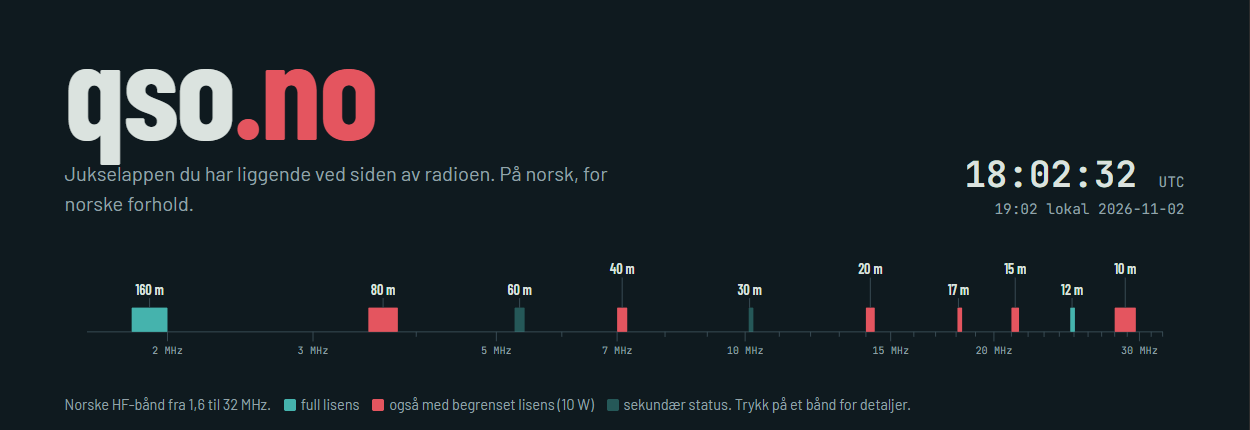
- A clickable band chart. All the Norwegian HF bands are drawn on one scale. The colours show which bands you can use with a full licence, which also allow the restricted licence (10 W), and which have secondary status. Click a band for the details.
- Search. Type QRM, 59, or a frequency like 7000, and find the answer quickly.
Take a look
Head over to qso.no and keep it open next time you’re on the air. If you’re helping someone new get started, it’s a good link to give them. And if you’re not licensed yet, Kallesignal.no will get you there.
If you spot a mistake or think something is missing, email me at contact@lb1dk.no.
73 de LB1DK