Log entry ·
Kallesignal: an online ham radio course for Norwegians
My latest project is Kallesignal.no, an online course in Norwegian, built from my LA2T course slides, that takes you all the way to the amateur radio licence exam. It has 129 short lessons, animations you control yourself, and mock exams built like the real one.
My latest project is Kallesignal.no, an online course that prepares you for the Norwegian amateur radio licence exam. Right now all the lessons are free. The tagline on the front page sums it up: “Veien til ditt eget kallesignal”, or “the road to your own callsign”.
From slide deck to online course
I teach licence courses for LA2T. The textbook we use, Veien til internasjonal radioamatørlisens, is pretty good, but the course evenings taught me something: students responded much more to the animations I built for my slides than to anything else. When a concept like resonance or the image frequency is moving on screen in front of you, it suddenly clicks.
So I took my slide deck and turned it into an online course that anyone can work through at their own pace, in Norwegian, wherever they live. Not everyone has a club nearby, and even if you do, a few course evenings is not always enough to make everything stick before exam day.
I’ve spent a lot of time quality checking the course: going over the content, the questions and the answers to make sure they’re correct and clear. Getting a licence means passing Nkom’s exam, and a course that teaches you something wrong is worse than no course at all.
What’s in it
The course is called Radioamatørkurs. It has 129 lessons across 24 modules and covers the whole syllabus:
- Electronics basics: Ohm’s law, capacitors and coils, AC, resonance, filters, diodes, transistors, FETs, op-amps, power supplies and even vacuum tubes
- Feed lines and matching: coax, SWR, impedance transformation and antenna tuners
- Propagation and antennas: the ionosphere, MUF/LUF, skip zones, dipoles, verticals, Yagis and dishes
- Transmitters and receivers: AM, FM, SSB, CW and digital modes, PLL/DDS, the superhet, AGC, link budgets
- Digital signal processing: sampling, aliasing, digital filters, SDR, I/Q and waterfalls
- Measurement, EMC and interference: what to do when the neighbour complains
- Operating, licensing and safety: QSO procedure, Q-codes, band plans, licence classes, the ITU Radio Regulations, and how not to get hurt
Every lesson has a title that tells you the point straight away. For example, “Desibel gjør gange til pluss, og 3 dB er dobbel effekt” (“decibels turn multiplication into addition, and 3 dB is double the power”). The idea is that you should be able to scroll the table of contents and get a summary of the whole syllabus.
Animations you control
This is the part I’m most excited about, and the reason the course exists. The animations from my slides are now interactive, so you turn the knobs yourself. You can change a frequency and watch the reactance change, or sweep a filter and see what gets through. I think a lot of radio theory only really lands once you’ve seen it move, and these make that much easier than a static diagram in a textbook.
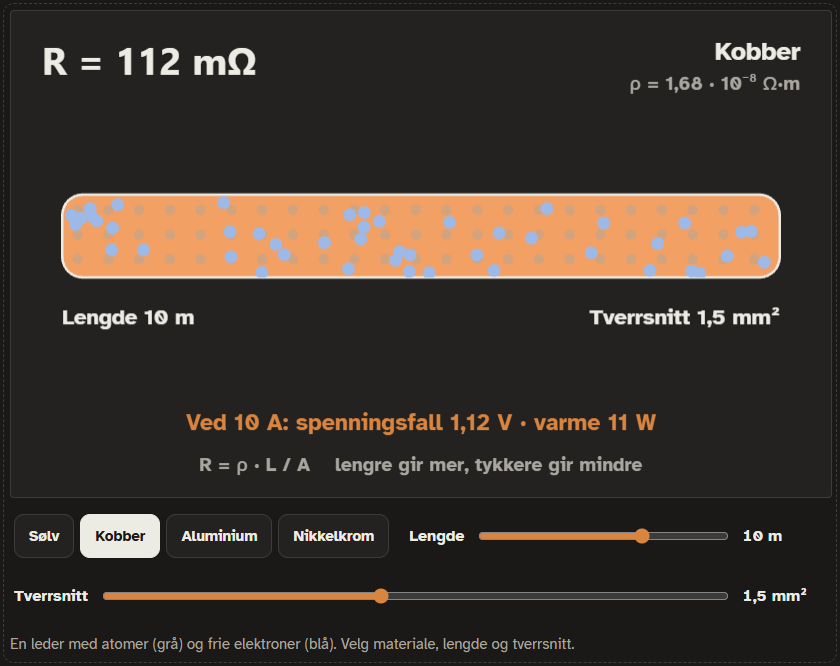
From the free Ohm’s law lesson: pick a material, change the length and thickness of the wire, and watch the resistance, voltage drop and heat change as the electrons flow.
Mock exams that work like the real thing
Under Prøver you’ll find three mock exams that will always be free. If you register for the course, you also get access to a large question bank that generates new mock exams on the fly, so you get a fresh exam every time. Every exam is set up like the real one:
- 60 multiple-choice questions
- 90 minutes
- You pass with at most 15 wrong answers
- Unanswered questions count as wrong
You need a free account so the site can save your results and let you go back through your answers afterwards.
One important caveat: Nkom doesn’t publish sample questions, so these are not the questions from the real exam. They’re written to cover the syllabus, and some will be easier and some harder than what you’ll see on the day.
Try it
The lessons are free for now. I plan to put the course behind a paywall later, so this is a good time to dig in. The three standard mock exams will stay free either way. You don’t need an account to start reading. Try a free lesson on Ohm’s law or jump straight into the full course. If you get stuck on a lesson, an exam question or logging in, there’s a help page where you can ask.
If you know someone who has been thinking about getting licensed, please send them the link. And if you find mistakes or have ideas for improvements, I’d love to hear about it at contact@lb1dk.no.
73 de LB1DK